
AI-Assisted Quantitative Trading & Research Infrastructure
Optimus Quanta orchestrates market scanning, quantitative research, strategy validation, portfolio and risk management, broker connectivity, reconciliation, and operator-supervised trading workflows across India and the United States.
Built for systematic research and controlled workflow automation — not investment advice, not fund management, and not a public capital product.
About Optimus Quanta
Private AI-native infrastructure for quantitative trading, research, validation, risk management, broker connectivity, reconciliation, and controlled execution workflows
Optimus Quanta is a private AI-native quantitative trading and research infrastructure platform with separate India and United States implementations built on a shared architecture for market scanning, quantitative research, simulation, strategy validation, portfolio and risk monitoring, broker connectivity, reconciliation, audit trails, AI-assisted operator workflows, and controlled execution.
The India implementation operates in Live Production. The United States implementation operates in Live Forward Validation. Shared architecture supports research, validation, monitoring, risk, reconciliation, audit, and controlled execution workflows across both markets.
Market-specific implementations preserve their own sessions, data, broker connectivity, and operational controls while sharing the same research and review principles.
Shared Research Layer
Market-specific universe scanning, breadth review, factor checks, and strategy documentation.
Shared Validation Layer
Backtesting, Monte Carlo testing, walk-forward validation, and stress-scenario analysis.
Market Control Layer
Risk checks, broker connectivity, reconciliation, audit trails, operator review, and controlled execution boundaries.
Market Deployments
Separate market implementations built on a shared quantitative trading, research, validation, risk, and operator-control architecture.
India Optimus
NSE Equities
Live production operations spanning systematic universe scanning, market breadth, quantitative research, strategy validation, portfolio and risk monitoring, Broker Connectivity, reconciliation, AI-assisted operator workflows, and controlled trading and execution infrastructure.
US Optimus
NYSE / Nasdaq Equities
US-session-aware infrastructure with a 6,700+ symbol US research universe, systematic scanning, quantitative research, simulation and validation workflows, portfolio and risk monitoring, Broker Connectivity, AI-assisted review, and continuous live forward-validation workflows.
Current Active Capabilities
Quantitative trading, research, validation, risk, reconciliation, and audit workflows supported by the private system
Across its India and United States implementations, Optimus Quanta supports scheduled or on-demand AI employee runs, universe scanning, market breadth review, backtesting, Monte Carlo simulations, walk-forward validation, stress-scenario review, broker connectivity, reconciliation, audit trails, and deployment-specific controlled execution workflows.
Caesar and Pontus can run research and risk-review tasks. Optimus AI can handle research queries, summarize validation results, compare simulation outputs, generate reports, and suggest follow-up research areas for operator review.
Dual-Market Universe Scanning
Market-specific equity scanning across India and United States universes, including a 6,700+ symbol US research universe, with private scan conditions kept inside operator workflows.
Market Breadth & Regime Review
Reviews participation, sector behavior, breadth, regime context, and structured operator review across market-specific sessions.
Research Lab & Validation
Supports backtesting, Monte Carlo simulation, walk-forward validation, stress testing, experiment review, and report generation.
Risk & Portfolio Intelligence
Reviews exposure, drawdown context, concentration, anomalies, risk state, and operator controls across deployment-specific portfolios and workflows.
Broker Connectivity & Reconciliation
Supports deployment-specific broker connectivity, internal-ledger comparison, broker-state review, and controlled workflow integration for operator review.
AI Employees & Operator Review
Supports research, validation, risk, audit, reporting, and boardroom-style review workflows while sensitive actions remain operator-controlled.
Infrastructure Architecture
Modular systems supporting market scanning, quantitative research, validation, risk, broker connectivity, reconciliation, and controlled execution workflows
Universe Scanning & Breadth
Runs parallel market scans, breadth checks, regime notes, and factor review workflows for structured research packets.
Research Lab & Simulations
Supports backtesting, Monte Carlo review, walk-forward validation, and controlled stress-scenario analysis.
Broker Connectivity & Reconciliation
Uses deployment-specific broker connectivity to compare internal ledgers, order records, and broker-state snapshots so operator dashboards can surface mismatches for review.
Risk Review Engine
Reviews exposure, drawdown conditions, concentration, rule conflicts, and workflow gates before sensitive operator actions.
Operator Kill Switch
Manual safety control plane for pausing workflows, blocking new actions, and enforcing operator-led intervention.
AI Research Copilot
Operator-facing assistant for research summaries, audit review, anomaly notes, and structured workflow explanations.
Dynamic Strategy Compiler
Natural-language strategy translation under controlled R&D validation. Production promotion requires testing, hardening, and execution-safety review.
Public Showcase
Sanitized product narrative and selected operational evidence
Restricted Operator Access
Private dashboard and review workflows for authorized operators
Private Core
Research engine, reconciliation services, audit logs, and controlled workflow execution
End-to-End Infrastructure Workflow
Operator-supervised quantitative trading and research workflow from universe scanning through reconciliation and audit
Execution behavior is deployment-specific and remains subject to market-specific controls, risk gates, and operator supervision.
AI-Assisted Workflow Layer
AI assists research, anomaly review, documentation, risk explanations, and audit trails
Across both market implementations, AI agents assist with research summaries, anomaly review, strategy documentation, market-regime notes, risk explanations, and audit-trail generation. AI does not independently manage public capital. Execution workflows remain safety-gated and operator-supervised.
Additional AI employees are planned for deployment to automate more research, validation, documentation, review-queue, and monitoring workflows. These future agents are intended to increase infrastructure autonomy around analysis and operations, not to independently execute trades or manage external capital.
Research Assistants
Summarize market regimes, scan signals, and prepare structured research notes.
Risk Review Agents
Highlight anomalies, exposure changes, drawdown conditions, and rule conflicts.
Audit Assistants
Generate decision rationale, workflow summaries, and provenance logs.
Operator Control
Human review remains central before sensitive actions or execution workflows.
Research autonomy does not mean unrestricted live trading autonomy. Not investment advice. Not fund management. Not a public capital product. No guaranteed returns.
Caesar Research Scanner
Universe scanning and EOD research packet preparation.
Pontus Risk Auditor
Systematic risk auditing, exposure review, and rule-conflict detection.
Athena Audit Trails
Compliance-style audit notes, review trails, and provenance summaries.
Brutus Reconciliation
Broker-state reconciliation and execution check summaries for operator review.
Daily AI Operator Briefing
Autonomous Research & Validation Employees
AI employees that can run the research cycle before the operator acts.
Optimus Quanta AI employees can autonomously run research and validation workflows such as backtesting, Monte Carlo simulation, walk-forward validation, scheduled universe scans, market breadth review, boardroom-style review cycles, report generation, and follow-up research suggestions.
The system is designed so specialized AI employees can coordinate across the Research Lab, Risk Review Engine, Market Breadth Engine, Broker Reconciliation layer, and Audit Trail layer. Their job is to prepare structured evidence, compare validation outcomes, surface weak assumptions, and present operator-facing conclusions before any sensitive action is considered.
This autonomy applies to research, validation, monitoring, documentation, reconciliation review, and decision-support workflows. Live broker-connected execution, where enabled, remains user-approved, risk-gated, and subject to operator controls and applicable broker/exchange requirements.
Research autonomy does not mean unrestricted live trading autonomy. Not investment advice. Not fund management. Not a public capital product. No guaranteed returns.
Backtest Runner
Runs structured historical validation workflows, compares setup behavior across symbols, and prepares result summaries for operator review.
Monte Carlo Validator
Stress-tests strategy outcomes across randomized paths, distribution assumptions, drawdown behavior, and robustness checks.
Walk-Forward Analyst
Validates whether rules remain stable across changing time windows, market regimes, and out-of-sample periods.
AI Boardroom
Coordinates research, risk, audit, and reconciliation agents into boardroom-style review cycles before conclusions are presented.
Report Generator
Creates operator-facing research packets, validation notes, weak-point summaries, and follow-up research suggestions.
Approval-Gated Execution
Where broker connectivity is enabled, execution workflows can be prepared for user approval, risk checks, and operator-supervised controls. This is not unrestricted autonomous public trading.
Q3 R&D Validation Track
Natural-language strategy research is under validation, not part of the production execution surface
Optimus Quanta is validating a natural-language strategy research layer where an operator can describe a setup in plain English and convert it into a structured research workflow.
Example: "Research a VCP setup for Indian equities. Define clean entry and exit rules, scan an appropriate India equity universe, validate the setup with backtesting, Monte Carlo simulation, and walk-forward testing, then generate a risk-review summary."
This module is under controlled R&D validation. It is intended to support equities first, with futures and options research workflows planned only after additional testing, hardening, and execution-safety review.
Futures & Options R&D Track
Planned derivatives research workflows after additional hardening.
Optimus Quanta is also planning an F&O research expansion with 24 pre-integrated futures and options strategy templates. These templates are intended for research, validation, simulation, comparison, and operator review workflows.
The F&O track is not positioned as a production execution surface at this stage. Rollout requires additional testing, hardening, risk review, broker/exchange compliance checks, and execution-safety validation.
Research autonomy does not mean unrestricted live trading autonomy.
Directional Futures Research
Research templates for directional futures hypotheses and regime-dependent validation.
Options Buying Research
Simulation workflows for premium-risk scenarios and controlled setup comparisons.
Options Selling Risk Review
Risk-first review of exposure, tail events, and adverse movement assumptions.
Spread Strategy Validation
Structured comparison of defined-risk spread behavior under validation conditions.
Expiry-Day Stress Testing
Scenario checks for volatility, liquidity, and timing-sensitive expiry behavior.
Greeks / Risk Exposure Review
Operator-facing summaries of sensitivity, exposure drift, and risk-state changes.
Stress-Tested Operational Evidence
Selected validation metrics are shown to demonstrate how the infrastructure behaved during controlled forward-simulation or pilot conditions. These figures are not projected investor returns and should be read only as technical evidence of workflow stability, drawdown control, reconciliation, and operator-supervised process behavior.
Friction & Workflow Realism
Optimus Quanta models market friction to preserve statistical integrity in infrastructure validation.
Latency & Slippage Emulation
Models network, queuing, and price movement assumptions in validation workflows.
Order Book Liquidity Modeling
Simulates fills relative to available depth so validation does not assume unrealistic execution.
Transaction Costs & Charges
Applies cost assumptions so observed results remain closer to operational conditions.
Intraday Queue Simulation
Models queue priority dynamics during high-velocity conditions to avoid optimistic fills.
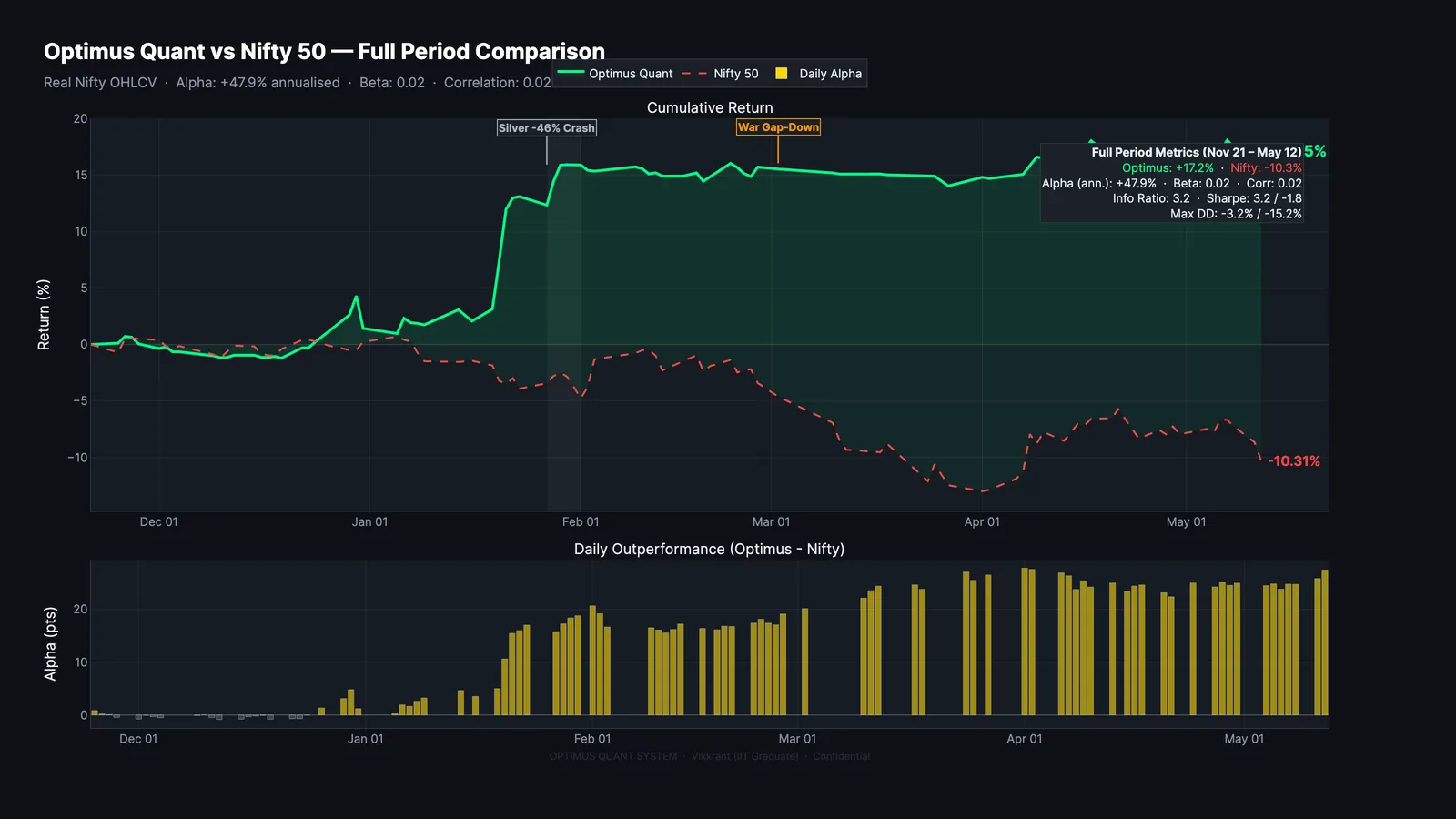
Infrastructure Validation: Controlled comparison of observed infrastructure behavior against a market benchmark during the validation window.
Stress-Tested Operational Evidence
During a severe commodity-market stress scenario, the workflow demonstrated controlled exit workflows, risk-state updates, and audit-ready evidence capture under validation conditions.
During a geopolitical gap-down stress scenario, the infrastructure preserved operator visibility across risk review, reconciliation, and controlled workflow evidence.
Why Validation Metrics Are Shown
The tracked metrics on this page are presented as operational evidence that the Optimus infrastructure can execute end-to-end quantitative workflows under controlled forward-simulation or pilot conditions. They are not shown as a solicitation for outside investment capital, nor as a public offer to manage external funds. Observed results are used to validate infrastructure behavior, execution discipline, workflow reliability, and risk controls.
Cloud Usage Plan
Cloud and AI infrastructure roadmap for scaling research, simulation, monitoring, and audit workloads
Optimus Quanta uses cloud infrastructure for distributed market-data processing, universe scanning, historical data storage, backtest workers, Monte Carlo simulations, vector retrieval, LLM-assisted research review, audit-log storage, secure dashboards, monitoring, and broker-state reconciliation.
Cloud and AI credits will be used to harden the research engine, scale simulation workloads, evaluate AI-agent workflows, improve observability, secure operator access, and prepare selected modules for a broader software release.
Compute
Parallel scanners, backtest workers, simulation jobs, and scheduled research tasks.
Storage
Historical datasets, sanitized logs, audit trails, simulation artifacts, and configuration history.
AI / LLM
Research summaries, strategy documentation, anomaly review, and agent workflow evaluation.
Security
Private access gateways, monitoring, secrets management, role-based access, and restricted dashboards.
Observability
System health, latency tracking, reconciliation alerts, error logs, and review queues.
Databases
Strategy metadata, broker-state snapshots, audit records, research notes, and experiment tracking.
What Optimus Quanta Is Not
Optimus Quanta is not a hedge fund, broker, investment adviser, portfolio manager, or public capital pool. The platform does not offer return guarantees, investment recommendations, or retail financial products.
Any performance evidence shown on this website is presented only as operational and technical validation of infrastructure behavior under controlled forward-simulation or pilot conditions.
Founder
Engineering-led development of AI-assisted quantitative infrastructure
Optimus Quanta is built by an IIT graduate with a focus on AI-assisted quantitative infrastructure, simulation systems, risk workflows, broker reconciliation, and operator-supervised execution architecture.
The work combines engineering training with hands-on development across systematic research workflows, cloud deployment, AI-agent orchestration, and trading-system risk controls.
Founder verification/profile link coming soon. Contact: [founder@optimusquanta.com]
Planned Public Product
The planned public product is intended for systematic researchers, developers, and advanced operators who need AI-assisted quantitative trading and research, backtesting, simulation, risk review, broker connectivity, and controlled workflow infrastructure. Any execution capability remains deployment-specific, safety-gated, and operator-supervised. The product is a software and infrastructure platform — not a public pooled-capital proposition.
FAQ
Plain-language answers for reviewers, operators, and future infrastructure partners
What is Optimus Quanta?
Optimus Quanta is a private AI-native quantitative trading and research infrastructure platform with separate India and United States implementations for market scanning, quantitative research, simulation, strategy validation, portfolio and risk monitoring, broker connectivity, reconciliation, audit trails, AI-assisted operator workflows, and controlled execution.
Is Optimus Quanta a trading bot?
No. Optimus Quanta is not merely a retail trading bot. It is a broader quantitative systems platform combining market scanning, research, validation, risk management, broker connectivity, reconciliation, audit, and controlled execution infrastructure. AI-assisted workflows remain safety-gated and operator-supervised.
Is Optimus Quanta a hedge fund or asset manager?
No. Optimus Quanta is not a hedge fund, broker, investment adviser, portfolio manager, or public capital pool.
Does Optimus Quanta provide investment advice?
No. The platform does not provide investment advice, financial recommendations, or return-guarantee products.
What does the AI layer do?
AI agents can coordinate autonomous research and validation workflows, including universe scanning, market breadth review, strategy documentation, backtest preparation, Monte Carlo simulations, walk-forward validation, anomaly review, boardroom-style discussion summaries, broker reconciliation summaries, report generation, and follow-up research suggestions. Execution workflows remain user-approved, risk-gated, and operator-supervised.
Does AI execute trades automatically?
No. AI employees do not independently execute trades. Optimus supports broker-connected and controlled execution workflows within deployment-specific strategy, risk, operator-control, and approval boundaries.
What is the current stage of Optimus Quanta?
Optimus Quanta has separate India and United States market implementations. India operates in Live Production, while the United States operates in Live Forward Validation. Shared research, validation, risk, audit, and operator-control infrastructure supports both deployments.
What cloud infrastructure does Optimus Quanta need?
The system needs cloud infrastructure for market-data pipelines, scanning workers, simulation engines, historical storage, vector retrieval, LLM evaluation, monitoring, audit logs, secure dashboards, and broker-state reconciliation.
Why are performance metrics shown?
Performance metrics are shown only as operational evidence of infrastructure behavior under controlled simulation or pilot conditions. They are not projected investor returns.
Who is the planned public product for?
The planned public product is intended for systematic researchers, developers, and advanced operators who need AI-assisted quant research, backtesting, simulation, review, and infrastructure workflows.
What makes Optimus Quanta different?
Optimus Quanta combines market scanning, simulation, AI-assisted review, risk monitoring, broker reconciliation, and audit trails into one operator-supervised quantitative infrastructure workflow.
Is private broker or account data shown publicly?
No. Public pages show only sanitized infrastructure descriptions and selected operational evidence. Private broker data, account data, and execution logs remain restricted.
Can I describe a strategy in natural language?
This is part of the Q3 R&D validation track. The planned strategy compiler is designed to translate plain-English research prompts into structured strategy logic, scan conditions, validation workflows, and review summaries. Production rollout requires testing, hardening, and execution-safety review.
What is an example natural-language research query?
Example: "Research a VCP setup for Indian equities, define entry and exit rules, scan an appropriate India equity universe, backtest the setup, run Monte Carlo and walk-forward validation, and produce a risk-review summary."
What are Caesar and Pontus?
Caesar is the scheduled research scanner for universe scans, market breadth, and EOD research packets. Pontus is the scheduled risk auditor for exposure review, anomaly detection, rule conflicts, and risk-state summaries.
Does Optimus support Broker Connectivity and reconciliation?
Yes. Broker Connectivity and broker-state reconciliation are part of the infrastructure. Deployment-specific broker connections can compare internal ledgers, order records, and broker snapshots to surface mismatches for operator review.
Do AI employees run research workflows autonomously?
Yes. Optimus Quanta AI employees can autonomously run research and validation workflows such as backtesting, Monte Carlo simulation, walk-forward validation, scheduled scans, market breadth review, boardroom-style review cycles, report generation, and follow-up research suggestions. This autonomy applies to research, validation, monitoring, reporting, reconciliation review, and decision-support workflows.
Can Optimus Quanta trade automatically?
Optimus Quanta supports broker-connected and controlled execution workflows within deployment-specific strategy, risk, and operator-control boundaries. The India implementation operates in Live Production, while the United States implementation is currently in Live Forward Validation. AI employees can prepare research, simulations, risk reviews, reports, and suggestions, but do not independently control live capital.
What makes the AI employee system different?
Instead of acting only as a chatbot, Optimus Quanta uses specialized AI employees to run structured research workflows. They can scan markets, run validations, compare backtests, review Monte Carlo and walk-forward results, conduct boardroom-style review cycles, generate reports, and suggest follow-up research actions.
Is futures and options support available?
Futures and options support is part of the R&D roadmap. Optimus Quanta is planning 24 pre-integrated F&O strategy templates for research, simulation, validation, and operator review. Production rollout requires additional testing, hardening, risk controls, and broker/exchange compliance checks.